Road markings are painted on the road surface itself — lines, symbols, arrows, and words that regulate and guide traffic. They carry exactly the same legal authority as physical road signs. Ignoring a road marking is a road traffic offence, and on the RSA driving test, marking violations are assessed as seriously as sign violations. This guide covers every marking used in Ireland, what it means, and what the law requires you to do.
Road Signs in Ireland — Article Series
In This Guide
- What Are Road Markings?
- White Centre Lines
- Broken White Centre Line
- Solid (Continuous) White Centre Line
- Double White Lines
- Edge Lines & Hazard Lines
- Stop & Yield Lines
- Yellow Lines — Parking Restrictions
- Single Yellow Line
- Double Yellow Line
- Yellow Box Junction
- Lane Markings & Arrows
- Bus Lane & Cycle Lane Markings
- Road Text — STOP, YIELD, SLOW & More
- Pedestrian Crossing Markings
- Quick-Reference Table
- Theory Test Tips
- Road Markings on the RSA Driving Test
- Frequently Asked Questions
What Are Road Markings?
Road markings are painted lines, symbols, arrows, and words applied to the road surface. Under the Road Traffic (Signs) Regulations, they form an integral part of the Irish road sign system and carry exactly the same legal force as physical signs. A marking on the road is not a suggestion — it is a legal instruction.
Road markings serve three main functions:
- Regulation — controlling what drivers may or may not do (e.g. centre lines, stop lines, yellow lines)
- Warning — alerting drivers to a hazard (e.g. hazard lines, give-way triangle)
- Guidance — showing drivers where to position their vehicle (e.g. lane arrows, edge lines, pedestrian crossing zones)
White Centre Lines
White — Centre & Lane LinesWhite lines along the centre of the road divide traffic travelling in opposite directions. The type of white line — broken, solid, or a combination — tells you immediately what overtaking is permitted. Understanding centre line markings is one of the most important skills a driver can have on rural roads.
Broken White Centre Line
Short dashes — lane boundary only; overtaking permitted when safe
A broken (dashed) white line in the centre of the road is a lane boundary marker. It separates lanes of traffic travelling in opposite directions on a normal two-way road. A broken line means you may cross it to overtake when:
- The road ahead is clear for a sufficient distance
- You can complete the overtake and return to your side before meeting any oncoming vehicle
- No other law or sign prohibits overtaking at that point
The broken line does not give permission to overtake carelessly — it simply means the marking itself does not prohibit it. All the normal rules of safe overtaking still apply.
Solid (Continuous) White Centre Line
Unbroken line — do not cross or straddle to overtake
A continuous (unbroken) white line in the centre of the road means you must not cross or straddle it to overtake. It is placed where the road ahead is particularly hazardous — on bends, near junctions, at the crests of hills, on narrow stretches, or in any position where the sight distance available to overtake safely is insufficient.
- Turning into a premises or side road on the right
- Passing a stationary obstruction in your lane (e.g. a broken-down vehicle)
- When directed to do so by a Garda or traffic signal
- Entering or leaving a lay-by
Double White Lines
Both solid — neither direction may cross to overtake
The rule applies to the driver who has the solid line on their side
Double white lines appear in the centre of the road as two parallel white lines. There are two configurations:
| Configuration | Your Side | Rule |
|---|---|---|
| Both lines solid | Either direction | Neither direction of traffic may cross or straddle the lines to overtake |
| Solid line nearest to you | Solid on your side | You must NOT cross or overtake — treat it as a continuous single white line |
| Broken line nearest to you | Broken on your side | You MAY cross to overtake if it is safe, providing you return to your side before reaching a section where the solid line is on your side |
Ready to put road markings into practice?
Book your EDT lessons with BP Driving School — RSA-approved, Swords, North Dublin.
Edge Lines & Hazard Lines
Edge lines and hazard lines mark the boundaries of the carriageway and warn of areas where extra caution is needed.
| Marking | Appearance | What It Means |
|---|---|---|
| White edge line | Solid white line along the left edge of the carriageway | Marks the left-hand boundary of the road. Do not drive to the left of this line except when parking, turning left into a side road, or passing a wide obstruction |
| Hazard line (long dashes) | White broken line with longer dashes and shorter gaps than a standard centre line | Warns that you are approaching a hazard — typically placed before a continuous white line begins. The lengthening dashes warn you to check before overtaking |
| Wide white edge line (hard shoulder) | Solid white line separating the hard shoulder from the main carriageway on national roads and motorways | Marks the boundary of the hard shoulder. In normal conditions you must not drive on the hard shoulder. On motorways it is reserved for emergencies and breakdowns only |
Stop & Yield Lines
Stop and yield lines are painted across the road at junctions and crossings. They tell you precisely where you must stop or give way. They work in combination with signs (STOP, YIELD) and traffic lights.
| Marking | Appearance | What It Means | Used With |
|---|---|---|---|
| Stop line | Single solid white line across the full width of the lane | Stop here — the front of your vehicle must not pass this line until it is safe and legal to proceed | STOP sign, red traffic light |
| Yield line | Single broken white line (wider gaps than centre line) across the full width of the lane | Give way to traffic on the major road — stop here if necessary before proceeding | YIELD sign, roundabout entries |
| Advanced stop line (cycle) | A second stop line set back from the main stop line, creating a box area for cyclists | Motor vehicles stop at the first (outer) stop line. The area between the two lines is reserved for cyclists to wait ahead of motor traffic | Traffic lights at busy urban junctions |
Yellow Lines — Parking Restrictions
Yellow — Parking RestrictionsYellow lines painted along the edge of the road indicate parking restrictions. Unlike white centre lines (which regulate movement), yellow lines regulate where you may stop and park. There are two types: single yellow and double yellow.
Single Yellow Line
No parking during the hours shown on nearby signs
A single yellow line runs along the edge of the road (usually near the kerb). It means parking is prohibited during the hours shown on nearby signs or supplementary plates. Outside those hours, parking is generally permitted alongside a single yellow line — but always check any nearby signs first.
| Situation | May you park? | May you stop briefly? |
|---|---|---|
| Single yellow line — during restricted hours | No | Generally no (unless loading/unloading or picking up/setting down where not causing obstruction — check local signs) |
| Single yellow line — outside restricted hours | Yes (unless other restrictions apply) | Yes |
Double Yellow Line
No parking at any time — 24 hours, 7 days
A double yellow line — two parallel yellow lines running along the edge of the road — means no parking at any time. The restriction applies 24 hours a day, 7 days a week, 365 days a year. No supplementary plate or sign is required — the double yellow line is self-explanatory.
| Situation | May you park? | May you stop briefly? |
|---|---|---|
| Double yellow line — any time | No — at any time | Brief stop to drop off/pick up may be permitted if not causing obstruction, but this varies — check local restrictions. On a clearway or in a bus lane, no stopping at all |
Yellow Box Junction
A yellow box junction is a grid of yellow diagonal lines painted on the road surface at a junction, typically a busy urban junction controlled by traffic lights. The yellow grid marks the area of the junction that must be kept clear of stationary vehicles.
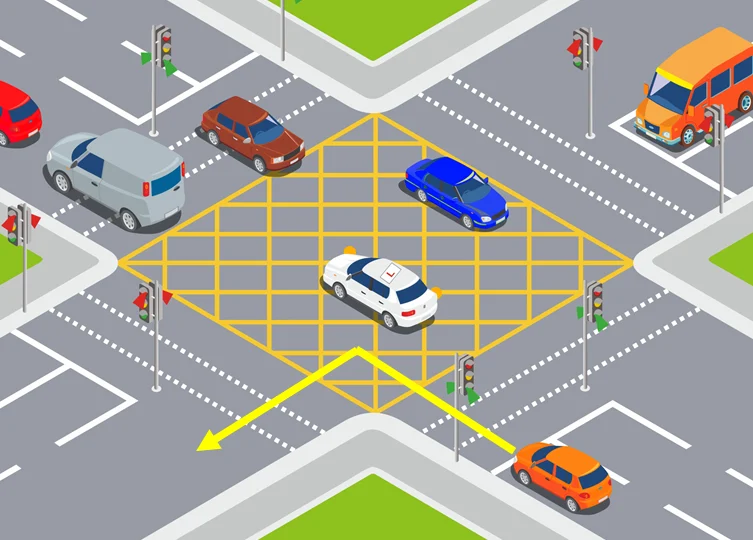
Yellow box junction — do not enter unless your exit is clear
The Yellow Box Rule
The rule is clear and absolute for the general case: do not enter a yellow box junction unless your exit is clear. Your exit is clear if, when the light turns green, you can drive through the entire box and out the other side without stopping. If there is stationary traffic in your exit road, do not enter the box — wait behind the stop line until your exit is clear.
| Situation | May you enter the box? |
|---|---|
| Going straight ahead — exit road clear | Yes |
| Going straight ahead — exit road blocked by stationary traffic | No — wait behind the stop line |
| Turning left — exit road clear | Yes |
| Turning left — exit road blocked by stationary traffic | No — wait behind the stop line |
| Turning right — blocked only by oncoming traffic or other vehicles turning right | Yes — you may enter the box to wait |
| Turning right — exit road also blocked by stationary traffic | No — do not enter the box |
Learning to drive in North Dublin?
BP Driving School covers Swords, Malahide, Portmarnock, Santry, Raheny and surrounding areas.
Lane Markings & Arrows
Lane markings divide the carriageway into lanes for traffic and direct drivers into the correct lane for their intended direction. They are particularly important at complex junctions, roundabouts, and on multi-lane roads.
| Marking | Appearance | What It Means |
|---|---|---|
| Lane dividing line | Broken white line between lanes travelling in the same direction | Separates lanes moving in the same direction. You may cross this line to change lanes when safe |
| Straight arrow | White arrow pointing ahead, painted in a lane | This lane is for traffic going straight ahead |
| Left turn arrow | White arrow curving left, painted in a lane | This lane is for traffic turning left |
| Right turn arrow | White arrow curving right, painted in a lane | This lane is for traffic turning right |
| Combined arrows | Arrow with two directions shown (e.g. straight and left) | This lane may be used for both directions shown |
| Diagonal stripe | Diagonal white lines in an area between lanes | A hatched or chevron area — do not enter unless it is safe and necessary to pass a stationary vehicle |
Bus Lane & Cycle Lane Markings
Bus lanes and cycle lanes have distinctive road markings that set them apart from general traffic lanes. These markings carry legal force — driving in a bus lane during operating hours is a road traffic offence.
| Marking | Appearance | What It Means |
|---|---|---|
| BUS LANE text | "BUS LANE" painted in white on the road surface, repeated at intervals along the lane | The lane is reserved for buses (and sometimes taxis and cyclists) during the hours shown on the entry sign. Do not drive in this lane during operating hours |
| Red surface (bus lane) | Red-painted road surface in the bus lane area | Used in addition to text markings in some urban areas to make the bus lane more visually prominent. The same rules apply |
| CYCLE LANE text & cycle symbol | "CYCLE LANE" or a painted cycle symbol in the lane | The lane is reserved for cyclists. Motor vehicles must not drive or park in a cycle lane during its operating hours |
| Green surface (cycle lane) | Green-painted road surface in the cycle lane | Used in some areas to highlight cycle lanes at junctions and conflict points. Motor vehicles must not enter |
| Contra-flow cycle lane | A cycle lane running in the opposite direction to traffic on a one-way street | Cyclists may use this lane going against the general flow of traffic. Motor vehicles must not enter |
Road Text — STOP, YIELD, SLOW & More
Words and symbols painted on the road surface reinforce signs and provide regulatory instructions directly at the point where action is required. They are particularly useful because they are visible to the driver from inside the vehicle even when they cannot see a sign on the side of the road.
| Road Text | Colour | What It Means |
|---|---|---|
| STOP | White | Reinforces the STOP sign at the junction — you must come to a complete stop before the stop line |
| STAD | White | Irish for STOP — equivalent to STOP in Irish-language areas; carries identical legal force |
| YIELD / GÉILL SLÍ | White | Reinforces the YIELD sign — give way to traffic on the major road |
| SLOW / GO MALL | White | Warning that a hazard or junction is ahead — reduce speed |
| BUS LANE | White | Marks a lane reserved for buses during operating hours — motor vehicles must not use the lane during those hours |
| KEEP CLEAR | White or Yellow | Do not stop in this area — used at fire station exits, hospital entrances, and other access points that must remain unobstructed at all times |
| 30 / 50 / 60 (speed) | White | Speed limit reminder painted on the road surface — reinforces a nearby speed limit sign |
| Triangle (give-way symbol) | White | A painted inverted triangle at some junctions — reinforces the YIELD sign and indicates the give-way line |
Pedestrian Crossing Markings
Different types of pedestrian crossings have different road markings. Knowing the markings helps you identify the type of crossing ahead and understand your obligations as a driver.
| Crossing Type | Road Markings | Driver Obligations |
|---|---|---|
| Zebra crossing | Black and white stripes across the road; zig-zag white lines on approach; two parallel broken white lines (give-way lines) just before the stripes | Give way to any pedestrian who has stepped onto the crossing or is waiting at the edge. Do not park on zig-zag lines. Do not overtake on the approach |
| Pelican crossing | Stop line at traffic lights; zig-zag lines on approach; pedestrian crossing area marked with road studs or lines | Stop on red and red/amber. Proceed on green only when crossing is clear. Give way to pedestrians still crossing when light turns green |
| Toucan crossing | As pelican crossing but wider to accommodate cyclists; cycle symbol may be painted on crossing area | As pelican crossing — give way to both pedestrians and cyclists using the crossing |
| Advanced stop line (cycle box) | Two stop lines — one for motor vehicles set back from the junction, one further forward for cyclists only; hatched or coloured box between them | Stop at the first (outer) stop line. Do not enter the cycle box area with a motor vehicle. Cyclists may wait ahead of motor traffic in the cycle box |
Quick-Reference Table — Road Markings
| Marking | Colour | Meaning | Legal Force | Driving Test Risk |
|---|---|---|---|---|
| Broken centre line | White | Lane boundary — overtaking permitted when safe | Yes | Low — safe crossing when clear is correct |
| Continuous centre line | White | No crossing or overtaking | Yes | Grade 3 if crossed to overtake |
| Double white (both solid) | White | Neither direction may cross | Yes | Grade 3 if crossed |
| Double white (one broken) | White | Driver with solid line on their side must not cross | Yes | Grade 3 if wrong-side driver crosses |
| Stop line (solid) | White | Stop before this line at STOP sign / red light | Yes | Grade 3 if vehicle passes the line |
| Yield line (broken) | White | Give way — stop here if needed | Yes | Grade 2–3 if traffic not given way to |
| Single yellow line | Yellow | No parking during hours shown on signs | Yes | Not on moving test route; offence if parked |
| Double yellow line | Yellow | No parking at any time | Yes | Not on moving test route; offence if parked |
| Yellow box junction | Yellow | Do not enter unless exit is clear | Yes | Grade 2 if entered with blocked exit |
| Lane arrow (direction) | White | This lane may only travel in direction shown | Yes | Grade 2–3 if wrong lane used |
| BUS LANE text | White | Lane reserved for buses during operating hours | Yes | Grade 2–3 if used during operating hours |
| KEEP CLEAR text | White/Yellow | Do not stop in this area | Yes | Grade 2 if stopped in this area |
| Zebra crossing stripes | Black & White | Give way to pedestrians on or waiting to cross | Yes | Grade 3 if pedestrian not given way to |
Theory Test Tips for Road Markings
Road markings appear throughout the RSA Driver Theory Test — particularly centre lines, yellow lines, and box junctions, which are among the most frequently tested topics across the entire theory test paper.
- Broken vs solid centre line: Broken = may cross when safe. Solid = must not cross (with limited exceptions). This is tested directly and repeatedly. Know it without hesitation.
- Double white lines — which side matters: The rule applies to your side. If the solid line is nearest you, you cannot cross. If the broken line is nearest you, you may cross when safe. Ignore what the other side's line looks like.
- Yellow box junction — the right-turn exception: This is the most tested nuance of yellow box rules. You may enter to turn right if only oncoming traffic or other right-turning vehicles prevent completion. You may not enter if the road you are turning into is also blocked.
- Single vs double yellow: Single = no parking during hours on sign. Double = no parking ever. The theory test will ask you to distinguish between them and state the correct restriction.
- Legal force of markings: The theory test often asks whether markings are legally enforceable. They are — with exactly the same force as signs. This is an important principle to know clearly.
- Zebra crossing rules: You must give way to a pedestrian who has stepped onto the crossing or is clearly waiting to cross. You must not overtake another vehicle that has stopped to give way at a zebra crossing.
Road Markings on the RSA Driving Test
Road markings are assessed continuously throughout the RSA driving test — every junction, every lane change, and every crossing point involves markings that the assessor observes. The key areas where markings most commonly cause test failures:
- Stop lines: Rolling past a stop line at a STOP sign or red light — even by inches — is a Grade 3 immediate fail. Stop before the line, with all four wheels stationary.
- Yellow box junctions: Entering a box with a blocked exit is a Grade 2 fault and is observed at every box junction on the route. Always check your exit before moving into the box — even when you have a green light.
- Lane arrows: Being in the wrong lane and then swerving across to correct is a serious fault. Read lane arrows well in advance and plan your position. If you miss your lane, take the route the lane directs you and reroute safely — do not cut across.
- Continuous white centre lines: If you cross a continuous white line on a rural section of the test route — even to pass a parked car without good reason — it is a Grade 2 or Grade 3 fault.
- Bus lanes: Driving in a bus lane during operating hours is a graded fault. Always check the bus lane entry sign for hours before entering any bus lane.
- Zebra crossings: Failing to give way to a pedestrian at a zebra crossing is one of the most serious driving test faults — it is a Grade 3 immediate fail. Approach every zebra crossing at a speed from which you can stop safely.
- Keep clear markings: Stopping in a KEEP CLEAR area — even briefly — is a fault. This includes stopping across a fire station exit or hospital access road.
Frequently Asked Questions
Continue in the Road Signs series
Understanding road markings in theory is one thing — reading them instantly under real traffic conditions is a skill built through practice with a qualified instructor. Book your EDT lessons with BP Driving School — RSA-approved, Swords, door-to-door pickup, manual & automatic.
Preparing for your test? Book a mock test to check your readiness before the real thing.